


Caption: Our consultations focus on finding your ideal preventative botox age through movement analysis, not guesswork.
You’re scrolling through photos from last weekend’s brunch, pinching to zoom on your smile, and there it is. Not a full-blown wrinkle. Just a faint line across your forehead that seems to linger a half-second longer than it used to when you relax your face. You immediately text your friend—the one who started getting injections at 25—and ask the question that’s been sitting in the back of your mind: what is the right preventative botox age, and have I already missed it?
Here’s the thing. Most people still picture Botox as something you get once the damage is done. Like calling a plumber after the pipe bursts. But preventative aesthetics has completely shifted that timeline. More and more patients are walking into clinics in their mid-to-late twenties not because they look older, but because they want to keep the skin they have now. And honestly? The science backs up the strategy—within reason.
But before you rush to book an appointment because TikTok told you to, let’s talk about what early neuromodulator use actually does, who it helps, and who should wait. Because the best time to start Botox isn’t a universal birthday. It’s a skin milestone.
Quick Answer: Preventative Botox age depends on your muscle movement and skin quality, not just your birthday. Most candidates begin in their late 20s to mid-30s when dynamic expression lines first appear at rest. The goal is to soften repetitive muscle contractions before they etch permanent static wrinkles, using smaller doses than corrective treatment.
Table of Contents
What Is Preventative Botox?
You’ve probably heard the term preventative aesthetics floating around Instagram or your group chat. It sounds like a marketing buzzword, but the concept is straightforward. Preventative Botox means using a neuromodulator—most commonly Botox Cosmetic, Dysport, or Xeomin—to temporarily relax the muscles that cause expression lines before those lines become etched into your skin at rest.
Think of it like wearing sunscreen. You don’t wait until you’re sunburned to start. You block the damage before it accumulates. Similarly, when you prevent wrinkles early by softening repetitive facial movements—like the constant furrowing that happens when you squint at your laptop or the brow raising you do when you’re surprised—you give your skin a break from the folding and creasing that eventually breaks down collagen.
That said, this isn’t about freezing your face into a mask. The best preventative work is invisible. You still emote. You still look like you. Just with slightly softer transitions in the high-movement zones.
We had a client last month who swore she could feel her glabella—the spot between her eyebrows—getting “heavier” from stress. She was twenty-eight. No deep lines yet, just a subtle crease when she concentrated. After a micro-dose treatment, she told us her headaches even felt milder. (Muscle tension relief is a nice side effect some people notice, though it’s not the primary goal.)
When to Start Botox: Finding Your Preventative Botox Age
This is the question that dominates every consultation. And honestly? There is no magic number. Your preventative botox age depends far more on your facial anatomy, muscle strength, and skin quality than on the year you were born.
Still, there are patterns we see in clinic. Let’s break it down by decade.
Botox in Your 20s: Is It Ever Too Early?
If you’re twenty-four and your skin bounces back perfectly after every smile, you probably don’t need injections yet. But if you’re twenty-seven and you notice a faint horizontal line across your forehead that remains visible even when your face is completely neutral, you’re already seeing the shift from dynamic to static.
Botox in your 20s makes the most sense for two groups: people with very expressive faces—think strong forehead movement or deep scowling when concentrating—and those with thinner skin that shows lines earlier. Doses are typically much lower than what’s used for correction. We’re talking about “Baby Botox” levels: tiny amounts scattered precisely to maintain natural movement while reducing the intensity of the contraction.
And here’s where it gets interesting. Starting in your mid-to-late twenties doesn’t mean you’ll need more Botox over time. It often means you’ll need less. Because you’re training those muscles to stay relaxed before they develop muscle memory for deep creasing.
The 30s Sweet Spot
For many people, the early 30s is when the collagen decline becomes visible. You might see crow’s feet that don’t fully smooth out after you stop laughing, or an “eleven” line between your brows that seems to deepen by the month. This is arguably the most common time patients ask when to start botox because the mirror finally confirms what photos have been hinting at.
The 30s are a sweet spot because the lines are still responsive to neuromodulators, but they’re present enough that you see a noticeable softening. Most patients in this range treat the forehead, glabella, and crow’s feet as a trio. It’s also when many people start combining their tox with medical-grade skincare or light laser to address texture at the same time.
Starting in Your 40s: Is It Too Late?
Not even close. While we call it “preventative” when we catch lines early, starting Botox in your 40s is simply corrective—and that’s perfectly fine. Your muscles have been moving for four decades, so they may need slightly higher doses or more frequent touch-ups to retrain. But the principle is identical: relax the muscle, soften the line, protect the skin.
Most people in their 40s see fantastic results. The key difference is that you may want to pair your neuromodulator with a collagen-stimulating treatment like RF microneedling or biostimulatory fillers to rebuild some of the structural support that has already faded.
How Preventative Botox Actually Works
To understand why this works, you need to know the difference between a dynamic wrinkle and a static one. Dynamic wrinkles appear only during movement—like the crinkles around your eyes when you genuinely laugh. Static wrinkles are the ones that stick around after the movement stops. Over time, every dynamic wrinkle has the potential to become static if the skin folds in the same spot thousands of times a year.
Botox is a purified protein that blocks the nerve signal telling a specific muscle to contract. When injected into the corrugator muscles between your brows or the frontalis muscle across your forehead, it creates a localized relaxation. The muscle still works; it just doesn’t scrunch as forcefully. Less force means less folding. Less folding means your skin maintains its smooth surface longer.
It’s one of the most effective ways to stop wrinkles before they start. But—and this matters—it only works on expression lines caused by muscle movement. It won’t prevent wrinkles caused by sun damage, dehydration, or sleeping on your side with your face smashed into a pillow. So if you’re hoping to prevent wrinkles early with injections alone while skipping SPF and retinoids, you’re playing defense with half a team.
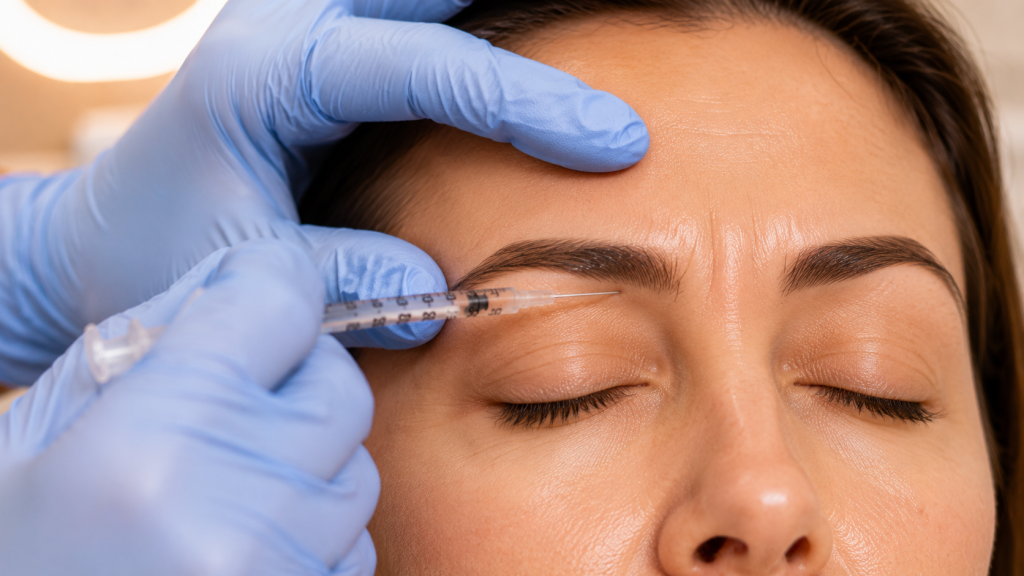
Caption: Precise placement in the forehead and glabella helps stop wrinkles before they start without sacrificing natural expression.
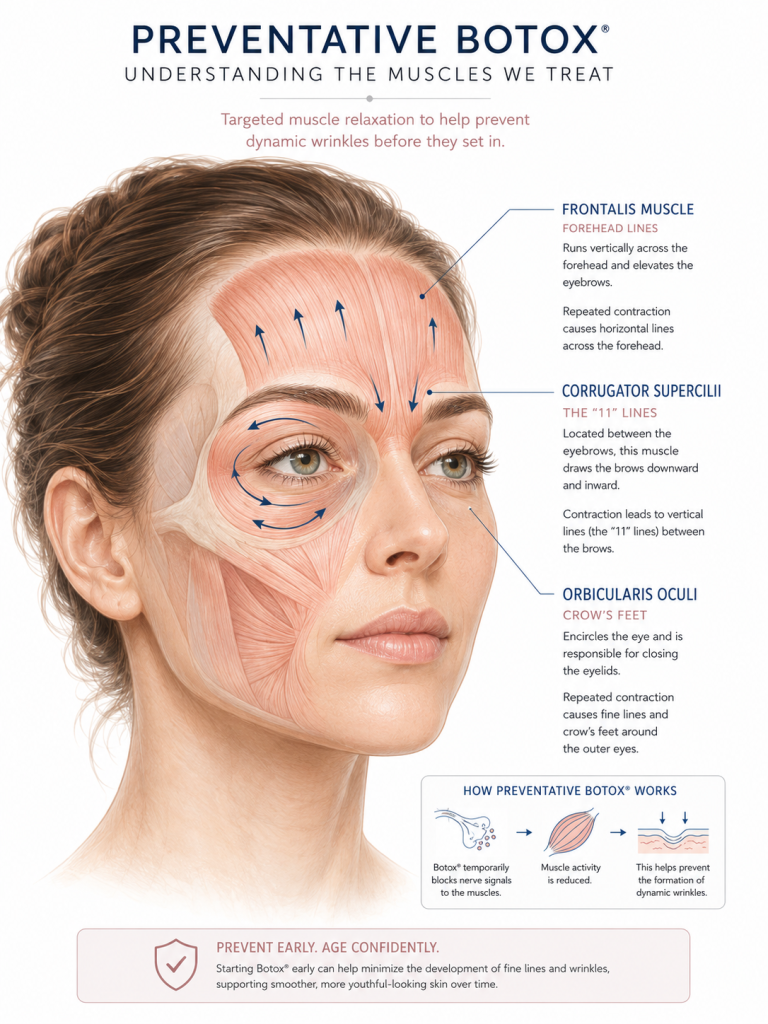
Skin Assessment Checklist: Are You a Good Candidate?
Not everyone needs preventative Botox. And honestly? We turn away just as many young patients as we treat. If your skin is still line-free at rest and you have minimal muscle movement, starting now is premature. You’ll spend money for results you can’t see, and your muscles may develop resistance over time if dosed unnecessarily.
Here’s the checklist we use during consultations. If you answer yes to three or more, it’s worth discussing:
- You see faint expression lines when your face is completely neutral. Look in a mirror under natural light. Relax every muscle. If a line remains, it’s no longer purely dynamic.
- You have strong facial expressions. If friends can read your mood from across a parking lot, your muscles are working overtime.
- Your mother or father developed deep forehead or frown lines relatively early. Genetics play a huge role in collagen quality and muscle bulk.
- You spend hours daily squinting at screens. The “computer scowl” is real, and it accelerates glabella lines.
- You already use medical-grade skincare and sunscreen consistently. Preventative aesthetics works best when you’re protecting your skin investment topically too.
- You have realistic expectations. You understand that Botox softens and delays; it does not freeze time or change your bone structure.
If you’re under twenty-five and none of the above apply, our advice is almost always the same: invest in a great skincare routine, wear SPF 30 or higher every single day, and revisit the conversation in a year or two.
What Preventative Botox Can’t Do (The Real Talk Section)
Let’s get honest for a minute. Preventative Botox is powerful, but it is not a time machine. It cannot rebuild collagen that has already degraded. It cannot lift sagging skin caused by volume loss. And it absolutely cannot replace the fundamentals: sunscreen, hydration, sleep, and genetics.
There is also a small but real risk of starting too early and too aggressively. If you completely immobilize a muscle before it has ever formed a line, you may alter the way surrounding muscles compensate. Some younger patients who over-treat their foreheads notice their brow depressors working harder, creating a subtle heaviness or droop. It’s fixable, but it’s annoying. And expensive to correct.
Plus, if you’re looking for a fixed budget item, Botox isn’t one. Results last three to four months. To truly maintain the preventative benefit, you need consistency. That means budgeting for three to four sessions per year, indefinitely. For some people in their twenties, that money is better allocated toward a series of chemical peels or a quality vitamin C serum that builds resilience without ongoing commitment.
We had a twenty-three-year-old come in last quarter requesting full-face tox because she saw it on YouTube. Her skin was flawless. No lines at rest, minimal movement. We told her to wait. She was relieved, actually. She just needed permission that “not yet” was a valid answer. (Most clinics worth your trust will tell you the truth even when it costs them a sale.)
What to Expect at Your First Appointment
If you’ve decided to explore your options, knowing what happens removes the intimidation factor. Your first visit should always begin with a facial assessment, not a syringe. A qualified provider will ask you to raise your eyebrows, squint, frown, and smile. They’re mapping your muscle strength and symmetry. Some people have a stronger forehead on one side; others have glabella muscles that pull downward rather than inward. These details change the injection pattern entirely.
The actual injections take ten to fifteen minutes. You’ll feel tiny pinches—like a mosquito bite—or nothing at all if ice or vibration distraction is used. There is no downtime. You can go back to work, run errands, or meet friends for dinner immediately after. The one rule we enforce strictly: no rubbing the treated areas and no lying flat for four hours. You don’t want the product migrating away from the precise muscles we targeted.
Results appear gradually over three to seven days. The first thing most patients notice isn’t a frozen forehead; it’s a softer landing. You make your usual expressions, but the skin doesn’t bunch as deeply. By day ten, you’ll see the full effect. If anything feels uneven or heavy, a quick touch-up at two weeks fixes it.
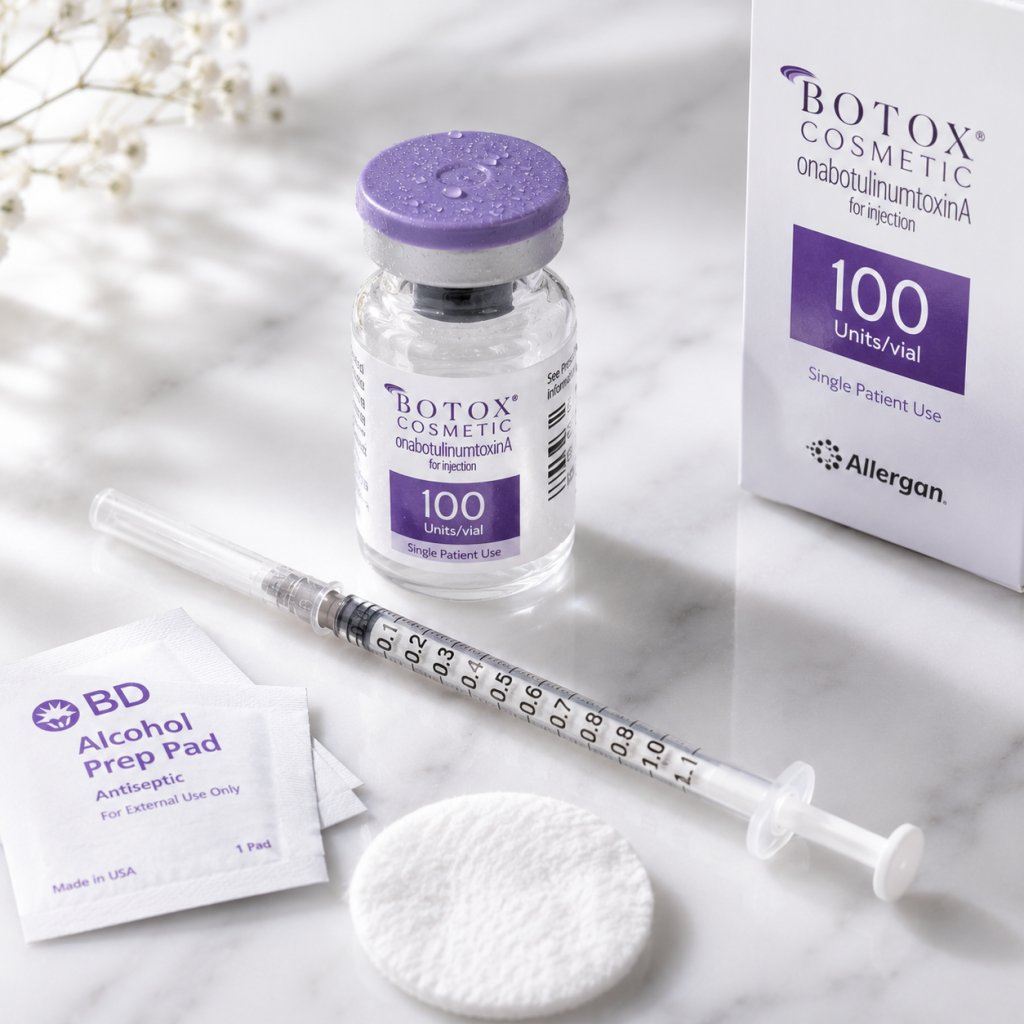
Caption: Botox Cosmetic remains the most studied neuromodulator for patients looking to prevent wrinkles early with predictable, subtle results.
Disclaimer: The information in this article is for educational purposes only and does not constitute medical advice. Individual results vary. A consultation with a qualified provider is required to determine candidacy for any treatment.