

You finally hit your goal weight. The scale shows a number you haven’t seen in years, your clothes fit differently, and honestly? You feel lighter in more ways than one. But then you catch your reflection in a car window or a Zoom meeting, and something looks… off. Your cheeks seem hollow. The skin around your jawline looks a little loose, almost tired. And those nasolabial folds—the lines running from your nose to your mouth—are more noticeable than ever.
Welcome to what everyone’s calling “Ozempic face.” It’s not a medical diagnosis, but if you’ve experienced rapid facial volume loss after weight loss, you know exactly how real it feels. Here’s the thing: when you drop weight quickly, your body doesn’t just burn the fat around your midsection. It pulls from everywhere, including the precious subcutaneous fat pads that keep your face looking youthful and full. Most people walk in thinking they’re suddenly aging overnight. You’re not. You’ve just lost the facial scaffolding that was propping up your skin. (And yes, it can be deeply frustrating when everyone comments on your weight loss but nobody mentions that your face looks drained.)
The good news? You don’t have to choose between a body you love and a face that matches. Aesthetic clinics now offer targeted ozempic face treatment protocols that restore what was lost and tighten what loosened—all without going under the knife.
Quick Answer: Ozempic face treatment combines dermal fillers to replace lost facial fat with energy-based skin tightening like RF microneedling or ultrasound therapy. Most patients need 2–3 sessions spaced 4–6 weeks apart, with results lasting 12–18 months depending on the approach.
Table of Contents
What Is Ozempic Face?
“Ozempic face” is the popular term for the gaunt, aged appearance that can follow rapid weight loss from GLP-1 medications like Ozempic, Wegovy, or Mounjaro. But this isn’t really about the drug itself—it’s about what happens when facial volume loss after weight loss occurs faster than your skin can adapt.
Your face carries several small fat pads that sit just beneath the skin. Think of them as natural pillows. They smooth transitions between facial zones, support your cheekbones, and keep the skin around your mouth and eyes from creasing. When weight drops quickly, those pads shrink. The skin, which has lost some elasticity over time, doesn’t always snap back. The result? A hollowed midface, deeper smile lines, and sometimes a slight sag along the jawline that makes you look older than you feel.
We had a client last month who lost forty pounds in four months. She was thrilled with her energy levels, but she kept pointing to her temples and saying, “I didn’t sign up for this.” We see it constantly. And honestly? It makes sense. The face is usually the first place people notice change, but it’s also the place where rapid change looks the most dramatic.
Why the Face Loses Volume So Fast
Here’s where it gets interesting. Not all fat is created equal. The fat in your face—specifically the subcutaneous fat layer—is structurally different from visceral fat around your organs. It’s more metabolically active and, unfortunately for your reflection, more responsive to calorie deficits.
When you lose weight gradually, your skin has time to contract through collagen remodeling. But GLP-1 medications often produce significant weight loss in 3–6 months. That’s simply too fast for collagen and elastin fibers to reorganize. Plus, if you’re over 35, your natural collagen production has already slowed down. The skin doesn’t just shrink; it drapes.
And there’s another factor. Many people on weight-loss medications are also eating less protein and fat overall, which can impact the amino acids your skin needs to repair itself. It’s a perfect storm: less facial fat, less skin elasticity, and fewer building blocks to fix either one.
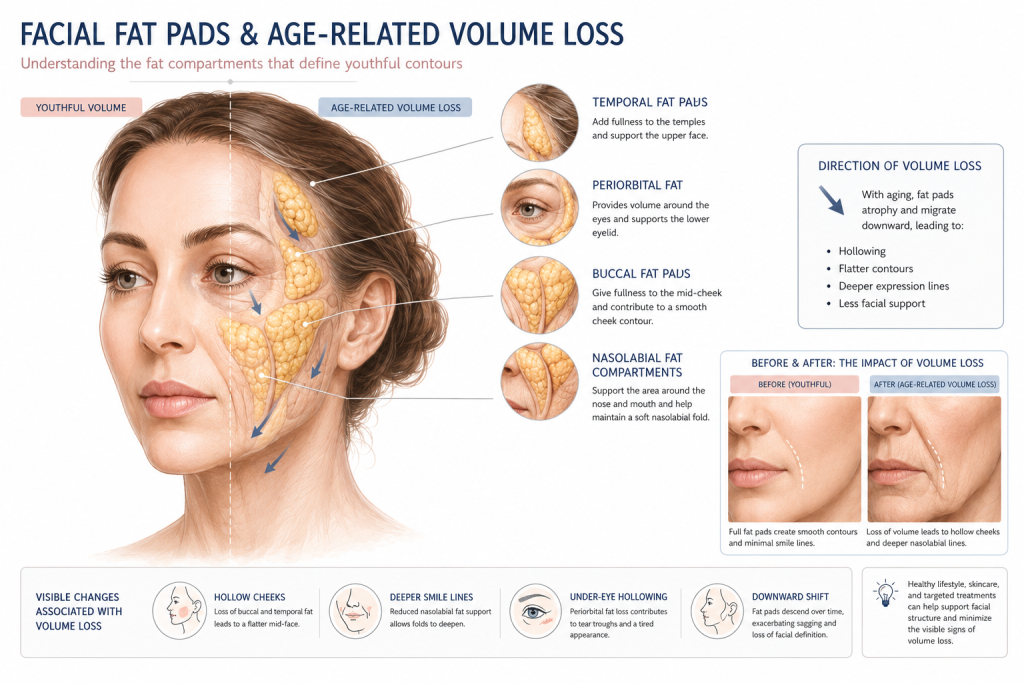
Caption: Understanding which facial zones lose volume first helps your provider map out a precise plan to restore facial fat naturally.
How Ozempic Face Treatment Works
Modern aesthetic medicine doesn’t treat Ozempic face with a single magic wand. The most effective approach is combination therapy: replacing what was lost (volume) while improving the quality of what remains (skin).
Fillers for Gaunt Face: Rebuilding the Structure
Fillers are the cornerstone of most ozempic face treatment plans. But we’re not talking about overfilled cheeks or the dreaded “pillow face.” The goal is structural restoration, not augmentation.
Your provider will likely use hyaluronic acid-based fillers like Juvederm Voluma or Restylane Lyft to rebuild the midface, temples, and sometimes the lateral jawline. These products contain a gel that mimics natural tissue and integrates with your existing fat pads. When placed with a microcannula—a blunt-tipped tool rather than a sharp needle—the result is smooth, even, and surprisingly comfortable. Most patients describe the sensation as pressure, not pain.
For patients with significant hollowing, we often treat multiple areas in one session. Temples, cheeks, and the prejowl area. The transformation isn’t dramatic in a cartoonish way. It’s subtle. You look rested. Like you got eight hours of sleep and a week at a beach. That’s the difference between fillers for gaunt face done well versus done excessively.
Results from hyaluronic acid fillers typically last 12–18 months in the face, though metabolically active patients—like those still losing weight—may see slightly faster breakdown. Your provider may recommend a maintenance plan to keep things balanced as your body composition stabilizes.
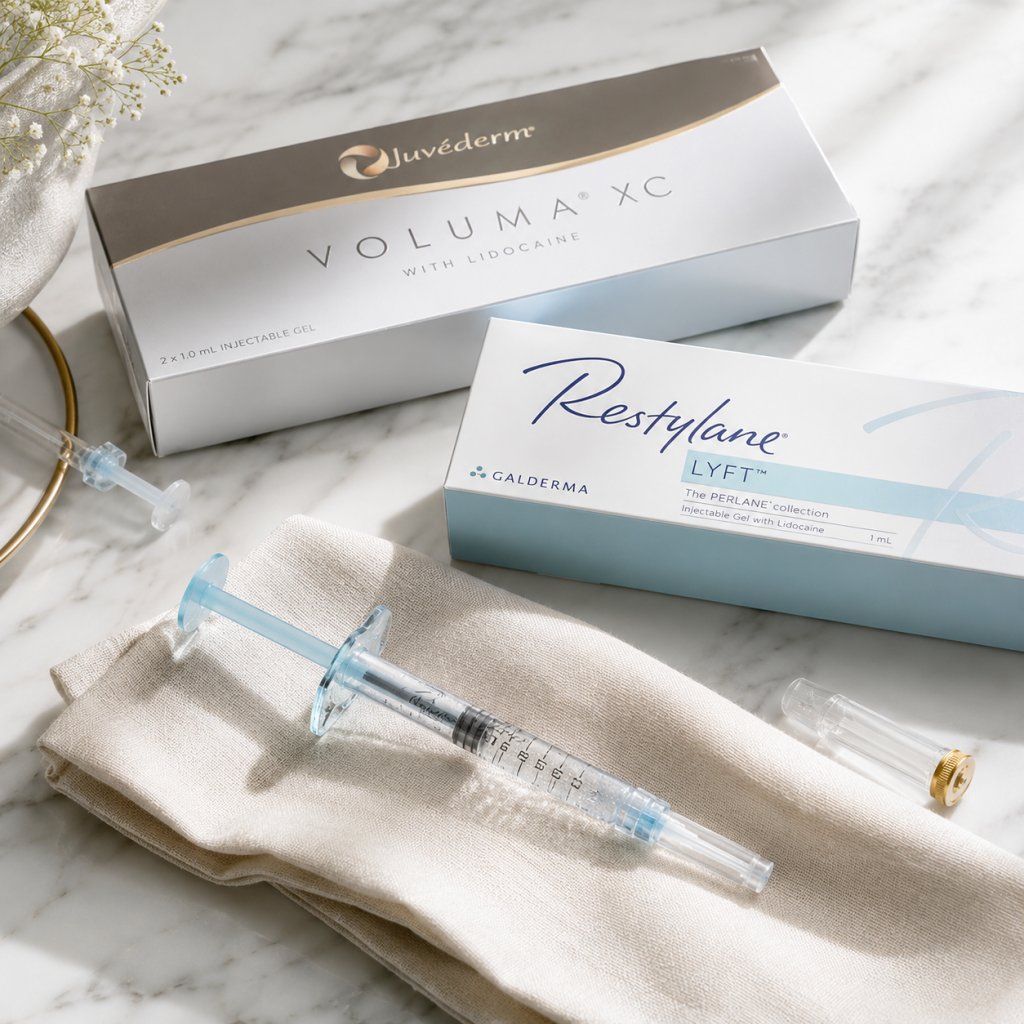
Caption: Premium hyaluronic acid fillers are the gold standard for patients looking to restore facial fat and soften hollow contours.
Skin Tightening After Weight Loss: Fixing the Envelope
Volume is only half the battle. If your skin has lost its snap, adding filler underneath can actually highlight laxity rather than hide it. That’s why skin tightening after weight loss is almost always part of the conversation.
Two technologies dominate this space right now:
RF Microneedling combines tiny needle punctures with radiofrequency energy delivered deep into the dermis. The needles create controlled micro-injuries that trigger collagen production, while the RF heat tightens existing fibers. Most patients need 3 sessions, spaced about a month apart. There’s minimal downtime—maybe 24–36 hours of redness that feels like a mild sunburn. You can usually wear makeup the next day.
Ultrasound Skin Tightening (like Ultherapy or Sofwave) uses focused ultrasound waves to heat the deep foundational layers of skin without disturbing the surface. It bypasses the epidermis entirely, which means zero downtime. The treatment feels like tiny hot prickles. Not exactly a spa day, but very tolerable. Results build over 2–3 months as new collagen forms.
Which one is better? It depends on your skin quality, age, and budget. RF microneedling tends to win for patients with mild texture issues or acne scars alongside laxity. Ultrasound works beautifully for patients who want zero recovery time and are mainly dealing with sag.
The Combination Approach: A Non Surgical Facelift for Weight Loss
When we combine strategic filler placement with energy-based skin tightening, we’re essentially performing a non surgical facelift for weight loss. No incisions. No general anesthesia. No weeks of hiding at home.
The sequencing matters. Most providers will do skin tightening first to improve the skin’s envelope, then add fillers 4–6 weeks later once the initial collagen remodeling has begun. This prevents overcorrection and ensures the filler sits in skin that’s better equipped to hold it.
Some clinics also add biostimulatory fillers like Sculptra or Radiesse into the mix. These don’t just fill; they trigger your own collagen production over time. Think of them as fertilizer for your facial structure. They take longer to show results—usually 6–8 weeks—but they last longer and can improve skin quality from the inside out.
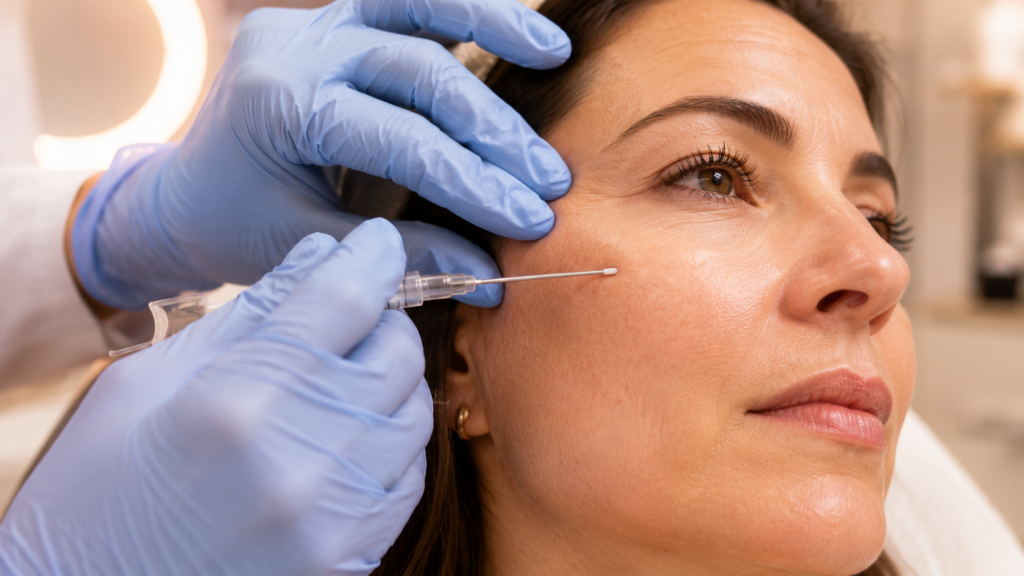
Caption: Microcannula techniques allow providers to rebuild volume while minimizing bruising, making ozempic face treatment more comfortable than most patients expect.
What to Expect During Your Visit
If you’ve never had fillers or energy treatments, the unknown can feel bigger than the actual experience. So let’s break it down.
Your first step is always a consultation. A trained provider will assess your face with you sitting upright (not lying down, which changes how gravity affects your skin). They’ll map out your fat loss patterns, check your skin elasticity by gently pinching and releasing, and ask about your weight-loss timeline. Are you still losing? Have you plateaued? This matters because we want to restore facial fat to a stable baseline, not a moving target.
During the treatment itself, expect about 45–60 minutes for fillers and 30–45 minutes for skin tightening. We use topical numbing cream for almost everything. For RF microneedling, some devices have built-in cooling or suction to reduce sensation. Afterward, you’ll get an ice pack, some arnica tablets if you’re prone to bruising, and very specific aftercare instructions.
Most people walk out looking slightly fuller immediately after fillers, though there will be some swelling. That swelling actually looks pretty good—like you just had a facial. The real results settle in at 2 weeks once the product has integrated and any minor bruising has faded.
What Ozempic Face Treatment Can’t Do (The Real Talk Section)
Let’s be honest for a second. Ozempic face treatment can work wonders, but it cannot stop your body from changing. If you’re still in active weight loss, your face may continue to shift. We usually recommend waiting until your weight has been stable for at least 2–3 months before investing in significant filler work.
Also, fillers cannot replicate the exact texture and behavior of natural facial fat. They come close—modern products are incredibly sophisticated—but they won’t move exactly like your native tissue when you smile or scrunch your face. An experienced injector knows how to place product to minimize this, but perfection is a myth.
And here’s something most blogs won’t tell you: if your skin laxity is severe—think significant jowls or neck bands—non-surgical treatments have limits. You might get 70–80% improvement, which is genuinely fantastic for no downtime. But if you’re expecting the results of a surgical facelift from a few syringes and some RF energy, you’ll be disappointed. We always set that expectation upfront because we’d rather under-promise and over-deliver than the reverse.
Recovery and Aftercare
The beauty of combination ozempic face treatment is that downtime is minimal, but there are rules.
For the first 48 hours after fillers:
- No intense exercise (increases blood flow and swelling)
- No alcohol (thins blood, worsens bruising)
- No sleeping face-down
- No facial massages or dental work that puts pressure on treated areas
For RF microneedling:
- No makeup for 24 hours
- No retinoids or acids for 3–5 days
- SPF 30+ religiously (your skin is temporarily more photosensitive)
For ultrasound tightening:
- Basically nothing. Maybe skip the sauna for a day if you’re sensitive.
Most patients return to work immediately. We had someone come in on her lunch break for Ultherapy and go straight back to Zoom calls. Nobody knew. (Well, her camera was off, but still.)