
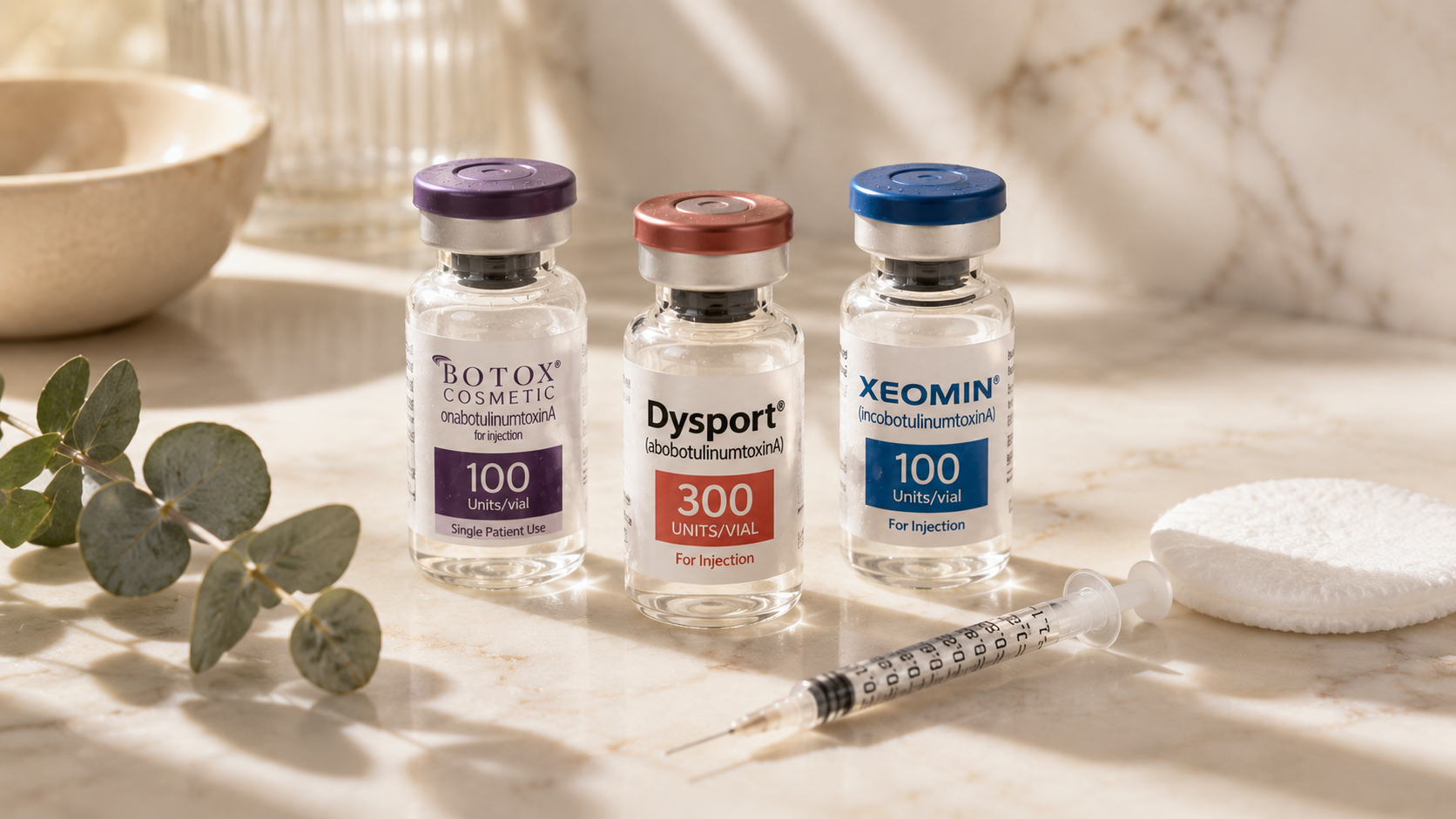
You’re finally ready. You’ve done the research, you’ve stared at your glabella lines in every reflective surface for three weeks, and you’ve decided that a wrinkle relaxer is the next step. You book the consultation, fill out the forms, and settle into the treatment chair feeling pretty proud of yourself. But then your provider asks a question that stops you cold: “So, do you want Botox, Dysport, or Xeomin?”
And suddenly you realize you’ve reached the final boss level of aesthetic decision-making. You thought the hard part was choosing to get treated. Turns out, that was just the tutorial.
If you’re sitting there with zero idea which neuromodulator to pick, you’re not behind. You’re normal. Most patients assume these three products are interchangeable, and in broad strokes, they are. They all smooth expression lines by relaxing specific muscles. But the botox vs dysport vs xeomin conversation gets interesting when you look at the details—how fast they work, how far they spread, and what else is in the vial besides the toxin itself. By the end of this guide, you’ll understand the difference between botox and dysport, know what sets xeomin vs botox results apart, and feel confident asking your provider the right questions. No biology degree required.
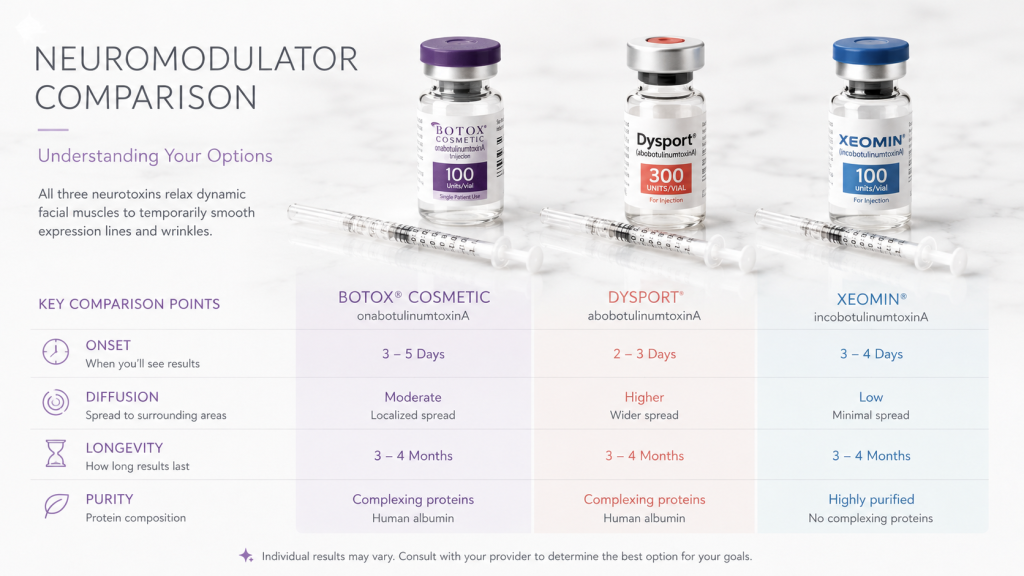
Caption: Understanding the difference between botox and dysport helps you choose the right neuromodulator for your specific concerns.
Quick Answer: All three are botulinum toxin type A neuromodulators that relax wrinkle-causing muscles. Botox is the most established brand, Dysport spreads more easily across larger areas, and Xeomin contains no accessory proteins. Results typically appear within 3–14 days and last 3–4 months. The best option depends on your anatomy and goals, not the brand name alone.
What Are Botox, Dysport, and Xeomin, Really?
Let’s strip away the marketing for a second. Botox, Dysport, and Xeomin are all injectable medications made from botulinum toxin type A. That’s the same neurotoxin, purified and diluted into a safe, medical-grade formula. When injected into a specific facial muscle, it blocks the nerve signal that tells that muscle to contract. The muscle relaxes. The skin on top of it stops folding. Over time, the line softens—or never forms in the first place.
Think of it like unplugging a lamp. The electricity can’t reach the bulb, so it doesn’t turn on. Your brain is still sending the signal to frown; the muscle just isn’t receiving it.
Botox Cosmetic was the first to market and still carries the name recognition. Dysport entered the scene with a slightly different protein structure and faster onset in some patients. Xeomin arrived last, advertising itself as the “naked” toxin with no unnecessary proteins attached. All three are FDA-approved for cosmetic use in specific areas, and all three are administered in units. But units are not interchangeable. One unit of Botox does not equal one unit of Dysport. Your provider handles the math; you just need to know that dosing is customized to the product, not copied and pasted.
Most people walk in thinking they need to pick the “strongest” one. But here’s the thing: in trained hands, all three can deliver excellent, natural looking results. The product is only half the equation. The other half is your injector’s understanding of your facial anatomy. (And honestly? That matters way more than the logo on the vial.)
The Real Difference Between Botox and Dysport
If you’re trying to choose between these two, the main difference comes down to molecular baggage and diffusion.
Botox contains the active toxin plus protective proteins called complexing proteins. These don’t change how the toxin works, but they do add weight to the molecule. Dysport also contains proteins, but its overall molecular structure is smaller and lighter. That smaller size means Dysport tends to spread a little farther from the injection point once it enters the tissue.
What does that mean for your face? Imagine you’re painting a wall. Botox is a fine-tip brush. It stays exactly where you place it, which is perfect for small, precise areas like the vertical lines between your brows or the delicate crow’s feet at the outer corners of your eyes. Dysport is more like a watercolor wash. It fans out slightly, which can be ideal for broader areas like the horizontal forehead lines, where you want a smooth, even relaxation without a bunch of tiny injection dots.
We had a client last month who swore her previous Botox looked “stripy” across her forehead. She had visible pockets of movement between the injection sites. We switched her to Dysport for that specific area, and the diffusion created a more uniform result. She looked refreshed, not treated. That’s the difference between botox and dysport in real life—not better or worse, just different tools for different jobs.
Plus, Dysport often kicks in a day or two faster for some patients. If you have an event on Saturday and you’re getting treated on Thursday, that slight edge in onset might matter to you. Botox typically takes five to seven days to show full results, while Dysport can start softening movement in as little as two to three days. That said, individual response varies. Your best friend might see Dysport work overnight while you notice nothing until day four.
Xeomin vs Botox Results: Does Purity Matter?
Xeomin entered the market with a compelling promise: same toxin, fewer extras. It’s often called the “naked” neurotoxin because the manufacturing process removes the complexing proteins, leaving only the purified botulinum toxin type A.
For first-time patients, xeomin vs botox results are remarkably similar. Most people cannot tell which product they received based on the smoothness of their forehead alone. Both typically last three to four months. Both soften lines without erasing expression. Both require the same post-treatment rules: no rubbing, no lying flat for four hours, no intense exercise until the next day.
So why choose Xeomin? Two reasons.
First, if you’ve been getting wrinkle relaxers for years and you swear they’re wearing off faster than they used to, you might be developing neutralizing antibodies to the accessory proteins in Botox or Dysport. This is rare—studies suggest it happens in less than 1–2% of long-term users—but when it does, your body essentially blocks the toxin before it can work. Because Xeomin has no complexing proteins, there’s less material for your immune system to react against. It’s a smart switch for patients who feel like they’ve hit a plateau.
We had a patient last year who had been getting Botox every four months for six years. She swore it was lasting eight weeks. We switched her to Xeomin and she immediately felt like she was back to her original timeline. Was it the product or a placebo? Hard to say definitively. But she was happy, and her results were consistent again.
Second, some providers find that Xeomin has a slightly quicker onset than Botox, often showing results in three to five days. And because it doesn’t have the extra proteins, it doesn’t need to be refrigerated, which some clinics appreciate for consistency. But for you as a patient, the practical difference is minimal. The vial still gets opened fresh. The syringe still looks the same.
And honestly? We use all three in our clinic. Some providers prefer Xeomin for the glabella because they feel it settles precisely. Others reach for Botox out of sheer familiarity. If your injector has a preference, ask why. Their reasoning usually reveals a lot about their technique.
Botox vs Dysport vs Xeomin: Onset, Diffusion, and Longevity
Here’s where we get organized. If you’re a visual learner, this wrinkle relaxer comparison is for you.
Table
| Feature | Botox | Dysport | Xeomin |
|---|---|---|---|
| Active Ingredient | Botulinum toxin type A | Botulinum toxin type A | Botulinum toxin type A |
| Onset of Results | 5–7 days typically | 2–3 days for many patients | 3–5 days typically |
| Spread/Diffusion | Low; stays very precise | Moderate; spreads slightly wider | Low to moderate; precise |
| Typical Duration | 3–4 months | 3–4 months | 3–4 months |
| Best For | Precision areas, first-timers | Larger areas like the forehead | Patients concerned about resistance, purity-focused |
| Protein Load | Contains complexing proteins | Contains proteins, smaller molecule | No accessory proteins (“naked”) |
| Unit Conversion | 1 unit | ~2.5–3 units = 1 Botox unit | 1 unit (similar to Botox) |
A few notes on this table. The unit conversion for Dysport is why you might see a higher unit number on your treatment plan. You’re not getting “more toxin” in a meaningful way; the units are just measured on a different scale. It’s like comparing Fahrenheit to Celsius. The temperature is the same; the number changes.
And longevity? Most patients see 3–4 months across the board. Some metabolize Dysport slightly faster. Some find Xeomin hangs on an extra week. But no wrinkle relaxer is permanent. If a provider tells you one lasts twice as long as another, that’s a red flag. They’re either inexperienced or overselling.
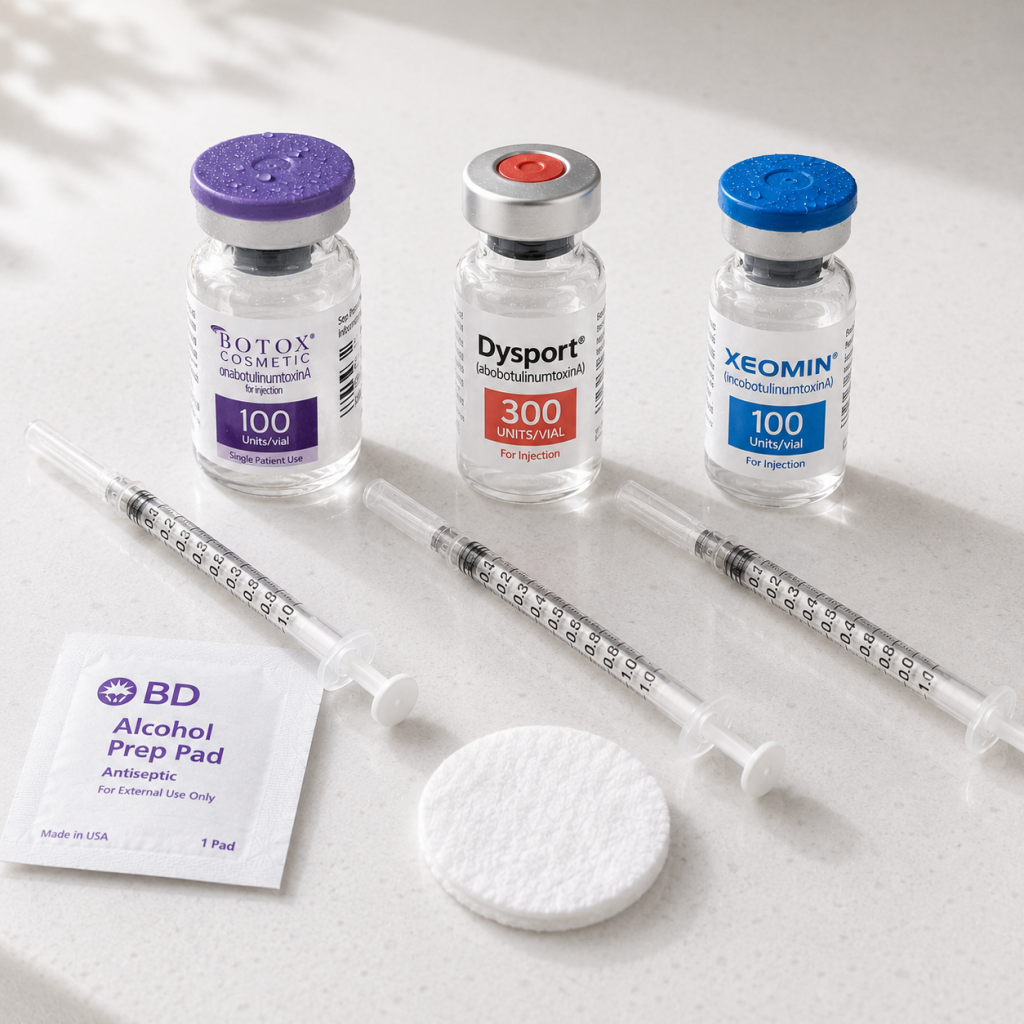
Caption: Each wrinkle relaxer offers unique advantages depending on whether you prioritize precision, spread, or purity in your treatment plan.
Which Neurotoxin Is Best for Each Treatment Area?
This is the question that actually matters. Because while the products are similar, their behavior changes depending on where they’re placed.
Forehead Lines (Horizontal) The forehead is a broad, flat sheet of muscle. You want smooth, even relaxation without a bunch of tiny frozen pockets. Dysport’s slightly wider diffusion pattern often wins here. It blends beautifully across the frontalis muscle. That said, an experienced injector can achieve an equally smooth result with Botox by using more injection points. If you want fewer needle pokes and your forehead is a priority, ask about Dysport.
Glabella / “The 11s” (Between the Brows) This area requires precision. The corrugator muscles are small, strong, and positioned close to your eyelids. You do not want product drifting downward. Botox and Xeomin both excel here because they stay exactly where they’re placed. Most providers have a slight preference for one or the other in this zone, and it usually comes down to what they were trained on first.
Crow’s Feet (Outer Eyes) The orbicularis oculi muscle is thin and wraps around the eye like a ring. Because the skin here is delicate and the muscle is close to the surface, precision matters. Botox is the classic choice. Xeomin also works well. Dysport can be used, but the injector must be extremely careful with depth and placement to avoid unwanted spread toward the cheek.
Bunny Lines / Lip Flip / Chin Dimpling These are micro-treatments. Tiny areas. Tiny muscles. You want the least diffusion possible. Botox or Xeomin are typically preferred. Dysport is rarely the first choice for these detail-oriented zones unless your provider has a very specific protocol.
Masseter / Jaw Slimming All three products work here. The masseter is a thick, powerful chewing muscle, so it requires higher dosing regardless of the brand. Some providers prefer Botox for consistency in large muscles. Others like Xeomin because the lack of proteins may reduce the risk of resistance over time with repeated high-dose treatments.
So when patients ask which neurotoxin is best, our answer is always: best for what? Your forehead might love Dysport while your glabella prefers Xeomin. A combination approach isn’t uncommon for patients who want the most tailored result.
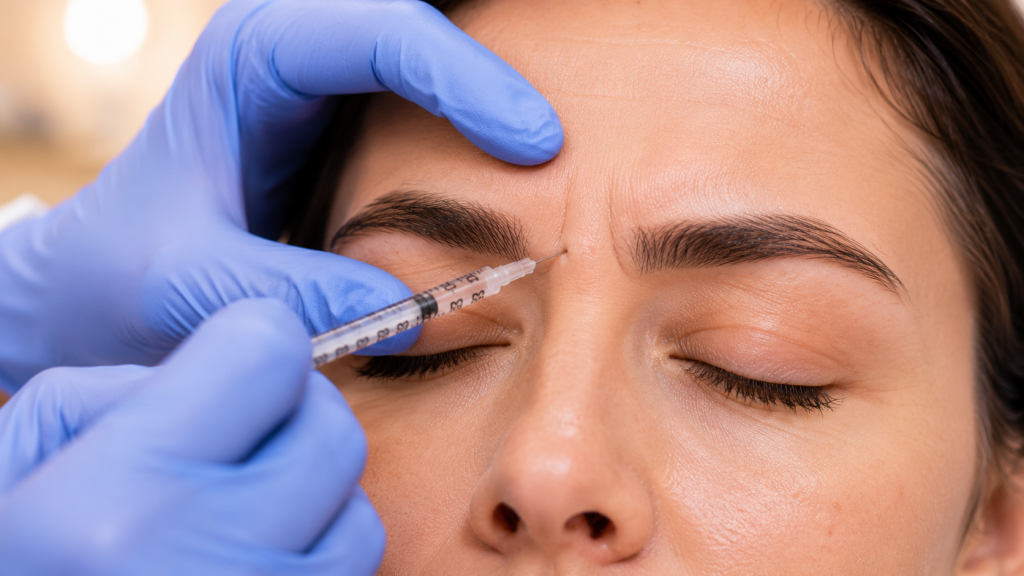
Caption: The secret to natural looking botox isn’t just the product—it’s the placement and dosing strategy your provider uses to preserve your expressions.
What These Wrinkle Relaxers Can’t Do (The Real Talk Section)
Let’s be honest for a minute. Wrinkle relaxers are incredible, but they are not magic. They cannot lift sagging skin caused by volume loss. They cannot tighten loose jowls. They cannot fill deep static creases that are already etched into your skin at rest. If your concern is skin laxity or hollowing, you need a different category of treatment entirely—think dermal fillers, RF microneedling, or ultrasound skin tightening.
They also cannot guarantee identical results every single time. Your metabolism changes. Your stress levels affect muscle tension. Even your workout intensity can influence how fast you burn through the product. Most patients see 3–4 months of smoothness, but we’ve seen everything from two months to six. Bodies are weird. (And frustratingly inconsistent.)
And here’s the part most comparison articles gloss over: natural looking botox has almost nothing to do with which vial your provider opens. It has everything to do with how many units they use, where they place them, and whether they understand your unique muscle pattern. We’ve seen gorgeous Dysport results and frozen Botox disasters. The product didn’t cause the problem; the dosing did.
We get asked constantly which one we would pick for ourselves. The truth? Most of us switch depending on what area we’re treating and what’s in stock that day. If a clinic pushes only one product and claims the others are inferior, that’s usually an inventory problem dressed up as expertise. A provider comfortable with all three will match the tool to your face, not the other way around.
Your Beginner’s Decision Framework
If you’re still spinning, here’s a simple way to land on a starting point.
Ask yourself:
- Do you want the fastest possible onset? Dysport often shows results a few days earlier, which is great if you have a timeline.
- Are you sensitive to additives or worried about long-term resistance? Xeomin’s protein-free formula is the cleanest option.
- Do you prefer the most established brand with decades of data? Botox is the household name for a reason. It’s predictable, well-studied, and widely available.
- Is this your first time ever? Any of the three will work. But Botox’s familiarity might make you feel more comfortable as a beginner.
- Are you treating a large area like the forehead? Dysport’s diffusion can be an advantage here.
- Do you need precision around the eyes or mouth? Botox or Xeomin may give your provider more control.
On top of that, consider your provider’s recommendation. If they’ve been using one product for ten years and know exactly how it behaves in your specific muscle type, that expertise often outweighs the theoretical differences on a chart. The best botox vs dysport vs xeomin comparison in the world means nothing if your injector is guessing.
And honestly? The only way to know for sure how your body responds is to try one. Most patients stick with their first choice if the result looks good. If it doesn’t, switching to another neuromodulator is simple. You’re not locked into a lifetime commitment with your first vial.